
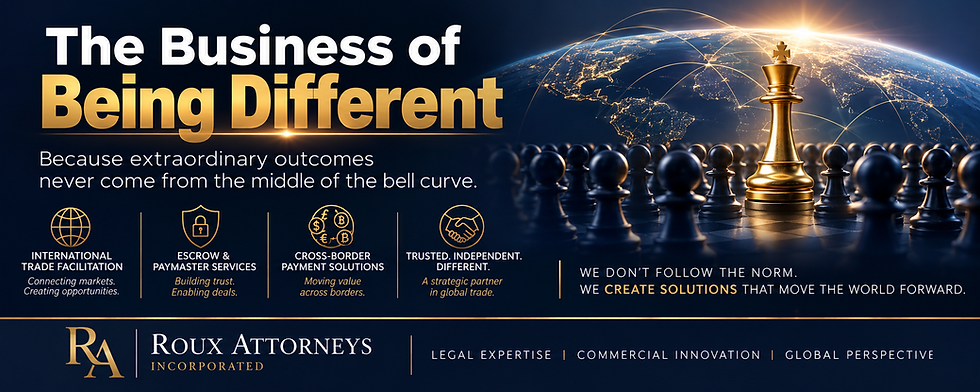
The Business of Being Different

Most people spend their lives trying to fit in.
Most businesses do the same.
They follow the accepted model. They copy what everyone else is doing. They offer the same services, speak the same language, charge the same fees, and wonder why nobody remembers them.
The irony is that the moment you optimise to fit in, you are, by definition, becoming average.
And average has a very specific meaning.
In statistics, the average sits in the centre of the bell curve. It is where the majority of observations exist. It is safe. Familiar. Predictable.
It is also statistically unremarkable.
Every time you suppress an original idea because it might sound unconventional...Every time you avoid a new approach because "that's not how it's normally done"...Every time you imitate instead of innovating...
...you voluntarily move yourself closer to the centre of the curve.
You reduce what makes you different.
You become interchangeable.
The problem is that extraordinary outcomes never come from the middle of the bell curve.
The companies that redefine industries are outliers.
The entrepreneurs who create entirely new markets are outliers.
The professionals who build global reputations are outliers.
Innovation has never been born from conformity.
The Legal Industry Has a Similar Problem
The legal profession has traditionally been built around precedent.
That is entirely appropriate when interpreting the law.
But it should never prevent innovation in the way legal services are delivered.
Too many firms still define themselves by what they have always done:
"We draft contracts."
"We litigate."
"We register companies."
"We collect debts."
All valuable services.
But today's clients operate in a world that looks very different from the one that existed twenty years ago.
International trade happens across multiple jurisdictions.
Businesses settle transactions using multiple currencies.
Digital assets are becoming part of legitimate commercial transactions.
Cross-border commodity trades require trusted independent intermediaries.
Traditional banking infrastructure is not always capable of supporting global commerce efficiently.
The question should not be:
"What does a law firm normally do?"
The better question is:
"What problem does the client need solved?"
We Didn't Want to Become Another Traditional Law Firm
At Roux Attorneys, we deliberately chose a different path.
Rather than limiting ourselves to conventional legal services, we built a practice around facilitating international commerce.
Today we work at the intersection of law, finance, technology and global trade.
We provide attorney-managed escrow and paymaster services that create trust between parties who may never have met.
We facilitate cross-border settlements involving both traditional banking systems and digital assets where appropriate and legally compliant.
We assist businesses with transaction structuring, risk mitigation, international payment solutions and complex commercial transactions across multiple jurisdictions.
In many transactions, our role extends beyond providing legal advice.
We become the trusted independent party that allows deals to happen.
That is very different from simply drafting documents after the commercial terms have already been agreed.
Different Is Not About Being Different
Being different simply to attract attention has very little value.
Innovation without purpose is merely novelty.
Our objective has never been to be unconventional.
Our objective has been to solve problems that traditional models often struggle to solve.
When a client faces foreign exchange restrictions...
When counterparties need an independent escrow solution...
When international buyers and sellers require confidence before funds move...
When cross-border payment complexity threatens to derail a transaction...
The answer is rarely another standard legal process.
It requires thinking beyond what a traditional law firm has historically provided.
Standing Apart Comes With Friction
Not everyone understands new ideas immediately.
Some people are sceptical.
Some assume that if something differs from the conventional model, it must be wrong.
History suggests otherwise.
Every meaningful innovation initially appeared unusual.
Every disruptive business model was once considered unconventional.
Every industry leader was once criticised for refusing to follow the established path.
That is simply the cost of creating something new.
Don't Aim for the Middle
There are billions of people on this planet.
Thousands of law firms.
Millions of businesses.
If your goal is merely to look like everyone else, success becomes a competition on price rather than value.
The organisations that create lasting impact are those willing to think differently, challenge assumptions and build solutions around the future rather than the past.
The same principle applies to individuals.
Don't suppress what makes you valuable simply to gain approval.
Don't dilute your ideas because they make others uncomfortable.
Don't confuse familiarity with excellence.
The world has enough average.
The future belongs to those prepared to stand outside the bell curve.
At Roux Attorneys, we don't aspire to be a conventional law firm. We aspire to be a trusted strategic partner in international trade—combining legal expertise, escrow and paymaster services, cross-border payment solutions, and commercial innovation to help businesses complete transactions that might otherwise never happen.
Because the most valuable solutions are rarely found by following the crowd.


Comments